AI agents are being positioned as the next major architectural shift in enterprise software. The promise is attractive: autonomous systems that can reason, plan, call tools, interact with APIs, collaborate with other agents, and complete business processes with limited human intervention.
That promise is real. But the current generation of agent systems often fails when moved from prototype to production. The issue is not simply that the models are “not smart enough.” The deeper problem is architectural. Most agent projects are built like impressive demos, not like scalable, governed, observable enterprise systems.
This article looks at AI agents as an architectural approach, why they are compelling, and why many of today’s implementations break down at scale.
What We Mean by an AI Agent
An AI agent is more than a chatbot. A chatbot responds. An agent acts.
A typical agentic system has several moving parts:
- A language model that interprets the user’s goal.
- A planning loop that determines the next actions to take.
- Tools or APIs that allow the agent to gather information, update systems, send messages, create tickets, run code, or start workflows.
- Memory or context that helps the agent remember past interactions and its current situation.
- Rules and guidelines that limit what the agent can do.
- A coordination layer that manages one or more agents, tools, and human involvement.
That last point matters. At enterprise scale, the agent is not the architecture. The agent is one component inside a wider architecture.
This is where many projects go wrong.
The Architectural Appeal
Agentic architectures are attractive because they seem to solve a long-standing enterprise problem: business processes are messy.
Traditional software prefers well-defined inputs, deterministic workflows, structured data, and predictable exceptions. Real business work does not always look like that. A support case, procurement request, architecture review, sales proposal, or compliance investigation may involve ambiguous language, incomplete data, multiple systems, and judgment calls. Agents appear useful because they can sit between human intent and system execution.
Instead of forcing users through rigid forms and workflows, an agent can interpret intent, gather missing information, decide which systems to query, and perform actions. In theory, this gives us a more flexible software architecture: less hard-coded workflow, more goal-directed execution.
That is the promise.
The problem is that flexibility also creates architectural risk.
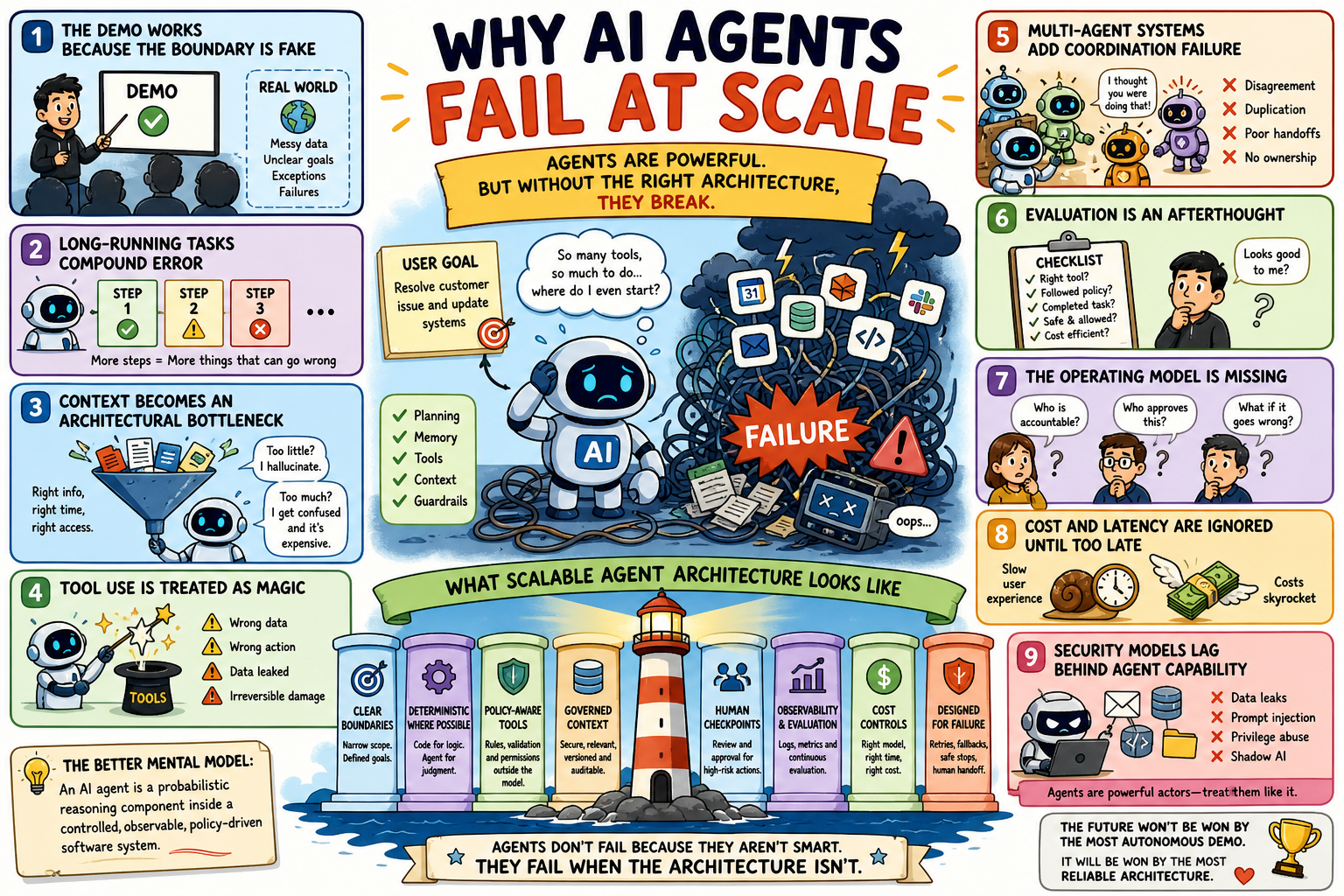
Failure Mode 1: The Demo Works Because the Boundary Is Fake
Most agent demos operate in a controlled world. The tools are limited. The data is clean. The user goal is narrow. The happy path is rehearsed. The cost of failure is low.
Production is different.
The agent has to deal with partial data, ambiguous requests, permission boundaries, latency, unavailable API’s, conflicting system states, stale documentation, and users who do not phrase things like prompt engineers.
This is why a demo that “books a meeting,” “triages a ticket,” or “summarises customer history” can look impressive but still fail in production. The demo proves that the model can perform a task once. It does not prove that the system can perform the task consistently, safely, and cheaply across thousands of messy real-world cases.
That distinction is central. Sierra’s τ-bench, for example, was designed to test whether agents can complete tool-using tasks consistently across repeated interactions, not just succeed once in a scripted run. Reliability over repeated execution is the real benchmark for agentic systems.
Failure Mode 2: Long-Running Tasks Compound Error
Agents struggle with long-horizon work.
A single model response may be good. A five-step workflow may be acceptable. A fifty-step workflow involving multiple tools, changing context, and decision points is much harder.
Each step introduces the chance of error: a misunderstood instruction, a poor tool choice, a malformed API call, a bad assumption, or a missed exception. In conventional software, we design deterministic workflows to reduce that risk. In agentic systems, the agent often chooses the workflow dynamically. That makes the system more adaptable, but also less predictable.
Research from METR frames this as the “time horizon” of tasks that AI systems can complete. Their work shows progress, but also reinforces the point that task length is a meaningful constraint: the longer the task, the more reliability matters.
This is one reason agents fail at scale. They are often asked to perform work that is too broad, too long-running, and too poorly bounded.
A practical rule: if you cannot describe the agent’s responsibility in a crisp service boundary, you probably do not have an agent architecture. You have a probabilistic intern with API access. ⚠️
Failure Mode 3: Context Becomes an Architectural Bottleneck
Agents are only as good as the context they receive.
In small experiments, context is usually hand-fed into the prompt. In production, context has to be retrieved, filtered, ranked, secured, refreshed, compressed, and audited. That is not a prompting problem. It is a data architecture problem.
The agent needs the right information, at the right time, with the right permissions, and within a reasonable cost and latency budget. Too little context and the agent hallucinates or asks unnecessary questions. Too much context and the model becomes slow, expensive, confused, or vulnerable to irrelevant instructions.
This is why “context engineering” is becoming a serious discipline. Modern approaches treat context as a governed, versioned, auditable product rather than a loose pile of documents stuffed into a prompt.
There is also a security angle. Some enterprise commentary argues that simple RAG-style designs can create risk when they centralise sensitive data into vector stores without preserving original access controls. Agent-based approaches can query live systems directly, but that only helps if authentication, authorisation, monitoring, and data-loss controls are properly designed.
The lesson is blunt: context is not a string. Context is infrastructure.
Failure Mode 4: Tool Use Is Treated as Magic
The seductive part of agents is tool use. Give the model access to functions, APIs, databases, browsers, calendars, ticketing systems, or code execution, and it can act.
But tool use is where architectural discipline matters most.
Every tool call has consequences. The agent may retrieve the wrong record, update the wrong field, send a message to the wrong person, expose sensitive information, or trigger an irreversible workflow. At small scale, you can manually inspect this. At enterprise scale, you need permissioning, transaction boundaries, validation, rollback, audit logs, and human approval for high-risk actions.
Many agents fail because tools are exposed too broadly. The model is given a large menu of capabilities and expected to choose wisely. That is fragile.
A better pattern is constrained agency. The agent should not have general access to everything. It should operate through narrow, typed, policy-aware tools that encode business rules outside the model.
For example, do not give an agent “access to ServiceNow.” Give it specific capabilities: “read incident by ID,” “summarise open incidents for this customer,” “propose priority change,” and “create draft resolution note.” Keep final approval separate where the business risk justifies it.
The model should reason. The platform should govern.
Failure Mode 5: Multi-Agent Systems Add Coordination Failure
Multi-agent systems sound elegant: one agent plans, another researches, another codes, another validates, another supervises. In practice, multi-agent systems often multiply failure modes.
Agents can disagree, duplicate work, pass poor context to each other, over-trust another agent’s output, or create loops where no component has clear ownership. Without strong orchestration, multi-agent systems become distributed ambiguity.
IBM describes a common enterprise narrative in which orchestrators coordinate networks of agents and models. That direction makes sense, but it also shifts the core architectural problem from “can one agent act?” to “how do we govern a system of acting components?”
This is not unlike microservices. Splitting a system into many services does not automatically make it scalable. It creates a need for contracts, observability, resilience patterns, deployment discipline, and governance. Multi-agent architectures have the same problem, except some of the components are probabilistic.
That is a harder architecture, not an easier one.
Failure Mode 6: Evaluation Is an Afterthought
Most agent projects do not fail because nobody tested the prompt. They fail because nobody built a serious evaluation system.
A production agent needs continuous evaluation. Not just “does the answer look good?”, but:
Did it choose the right tool?
Did it follow policy?
Did it retrieve permitted data only?
Did it complete the task?
Did it ask for human approval when required?
Did it avoid unnecessary cost?
Did it degrade gracefully?
Did it produce an auditable trace?
AWS’s guidance on evaluating agentic systems stresses operational dashboards, alert thresholds, anomaly detection, feedback loops, and alignment with business objectives. That is the right direction: agent evaluation belongs in the runtime architecture, not in a spreadsheet during the proof of concept.
LangChain has also argued for human judgment in the improvement loop, using automated evaluations on production data to surface situations that need human review. This is important because user surveys alone do not capture actual agent behaviour.
In other words, production agents need observability plus evaluation. Logs tell you what happened. Evaluations tell you whether what happened was acceptable.
Failure Mode 7: The Operating Model Is Missing
Scaling agents is not just a technical problem. It changes how work is done.
If an agent drafts a customer response, who is accountable for the final message?
If an agent approves a refund, who owns the policy decision?
If an agent updates a system of record incorrectly, who detects and reverses it?
If an agent uses confidential data inappropriately, who is responsible?
McKinsey argues that scaling agentic AI requires a new operating and governance model, with humans shifting from execution toward supervision and orchestration. That is a significant organisational change, not a tooling upgrade.
This is where many enterprise agent programmes underperform. They focus on building agents, but not on redesigning the human-agent workflow around them.
The result is predictable: unclear ownership, nervous stakeholders, shadow AI usage, compliance anxiety, and pilots that never graduate to production.
Failure Mode 8: Cost and Latency Are Ignored Until Too Late
Agents are expensive in ways that normal applications are not.
A single user request might trigger multiple model calls, retrieval operations, tool calls, retries, planning steps, validation checks, and summarisation passes. A multi-agent workflow can multiply that again.
This creates two scaling pressures.
First, latency. Users may tolerate a slow agent in a demo. They will not tolerate a business process that takes thirty seconds every time because five agents are debating the next step.
Second, cost. Token usage, model selection, retrieval, tool execution, and evaluation all accumulate. Gartner has warned that many agentic AI projects may be scrapped because of rising costs and unclear business value, with a notable amount of “agent washing” in the market.
The architectural correction is to design for cost from the start. Use smaller models where possible. Cache safe intermediate results. Avoid unnecessary multi-agent loops. Prefer deterministic code for deterministic work. Reserve expensive reasoning for points where it actually adds value.
A good agent architecture is not “LLM everywhere.” It is “LLM where judgment is useful.”
Failure Mode 9: Security Models Lag Behind Agent Capability
Agents can behave like users, but faster and with less predictable intent.
That creates security problems. An agent may have access to email, files, CRM records, source code, calendars, and internal knowledge. If compromised or poorly constrained, it can leak data, take unsafe actions, or bypass traditional controls by acting through legitimate user paths.
Recent reporting on shadow AI and agentic tools highlights risks around unsanctioned tools, corporate data exposure, malicious extensions, and agents that can access emails, execute code, and manage files. Recommended mitigations include approved alternatives, DLP policies, sandboxing, and monitoring AI-specific threats.
This matters architecturally because traditional security assumes relatively predictable application behaviour. Agents are more dynamic. They need identity, least privilege, policy enforcement, prompt-injection resistance, tool-level permissions, audit trails, and sandboxing.
Do not attach an agent to enterprise systems without treating it as a privileged actor.
What Scalable Agent Architecture Should Look Like
A scalable agent architecture is not a clever prompt wrapped around a model. It is a governed execution platform.
It should have clear roles for each agent. Each agent needs a specific purpose, a set of tools to use, and clear goals for success.
It should follow set processes whenever possible. Agents shouldn’t make up parts of the process that can be programmed as regular software.
It should use tools that are aware of policies. Business rules, permissions, checks, and actions that can’t be undone should be separated from the main model.
It should manage context carefully. Context should be organized, filtered, allowed based on permissions, saved in versions, and monitored.
It should include checkpoints for human review. Actions that are risky should need review, approval, or a way to escalate the situation.
It should be fully observable. Every plan, tool use, model response, decision, and result should be easy to trace.
It should be continuously evaluated. Agents should be assessed based on business results, adherence to policies, task completion, costs, speed, and safety.
It should control costs. The design should determine when to use large models, small models, stored results, programmed solutions, or avoid AI altogether.
It should be ready for failure. Agents need backup plans, options to try again, ways to stop safely, alternative actions, and a smooth handover to humans when needed.
The Better Mental Model
The wrong mental model is this:
“An AI agent is a digital worker. Give it a goal and let it operate.”
The better model is this:
“An AI agent is a probabilistic reasoning component inside a controlled, observable, policy-driven software system.”
That distinction changes the architecture.
You stop asking, “How autonomous can we make it?”
You start asking, “Where does autonomy create value, and where does it create unacceptable risk?”
That is the mature question.
Conclusion
AI agents are not a dead end. They are a useful architectural pattern, especially where work involves ambiguity, language, judgment, and interaction across multiple systems.
But today’s agent approaches often fail at scale because they confuse autonomy with architecture. They rely on model intelligence where they need system design. They treat context as a prompt problem, tools as magic, evaluation as optional, and governance as something to add later.
The path forward is not to abandon agents. It is to architect them properly.
Agents need boundaries. They need orchestration. They need governed context. They need narrow tools. They need observability. They need evaluation. They need human supervision in the right places.
The future of agentic AI will not be won by the most autonomous demo. It will be won by the most reliable architecture. 🧭