As software architects, we’ve witnessed seismic shifts in how we build applications. From monoliths to service-oriented architectures, and then to the ubiquitous micro services, each transition fundamentally changed our approach to complexity, scalability, and resilience. Today, we stand on the precipice of another such transformation: Agentic AI: The Next Architecture Standard
For the past few years, the excitement around AI has primarily revolved around large language models (LLM’s) and their incredible generative capabilities. We’ve built applications that integrate LLM’s to summarise, generate text, and answer questions. These applications often treat the LLM as a single, powerful, yet ultimately monolithic black box. You provide a prompt, the LLM provides a response. Simple, effective, but inherently limited for complex, goal-oriented tasks.
This approach is akin to the early days of monolithic applications. While powerful, they struggled with:
- Scalability: A single failure could bring down the entire system.
- Maintainability: Changes in one area could have unforeseen impacts elsewhere.
- Specialization: One component had to do everything, often inefficiently.
From Monolithic LLM’s to Multi-Agent Systems
The “Microservices Moment” for AI signifies a departure from this monolithic LLM paradigm towards Multi-Agent Systems (MAS). Just as we broke down large applications into small, independent, and specialized microservices, we are now breaking down complex AI tasks into networks of collaborating, specialized AI agents.
What does this look like in practice?
Instead of a single LLM trying to tackle an entire problem, imagine a team of dedicated AI agents, each with its own role, tools, and objectives, working together.
Consider a complex task, like “Develop a new feature for our help desk platform”:
- The “Product Agent”: Analyzes user feedback, market trends, and business requirements to define the feature’s scope and user stories.
- The “Architect Agent”: Designs the high-level system architecture, considering existing services, data models, and performance requirements.
- The “Coding Agent”: Generates the necessary code, adhering to coding standards and best practices. It might interact with a Git repository, IDE, and even test frameworks.
- The “Testing Agent”: Develops and executes unit, integration, and end-to-end tests, reporting bugs back to the Coding Agent for remediation.
- The “Security Agent”: Scans the generated code for vulnerabilities, ensuring compliance with security policies.
- The “Deployment Agent”: Orchestrates the deployment pipeline, ensuring the new feature is rolled out safely and efficiently.
- The “Reviewer Agent”: Critiques the code, tests, and documentation generated by other agents, providing feedback for refinement.
This collaborative model dramatically enhances robustness, scalability, and specialisation. Each agent can be fine-tuned for its specific role, equipped with unique tools (APIs, databases, external models), and operate semi-autonomously or fully autonomously.
The Architectural Implications for Architects
For us, the shift is profound:
- Orchestration, Not Just Prompt Engineering: Our role evolves from crafting clever prompts to designing intricate agentic workflows, defining communication protocols, and managing agent interactions.
- State Management is Key: Agents need memory – both short-term (contextual awareness) and long-term (knowledge bases, past experiences) – to maintain continuity across tasks. Vector databases and specialised memory layers become central.
- Tooling and APIs are Paramount: The effectiveness of an agent is directly proportional to the quality and breadth of the tools it can access. API-first design becomes even more critical.
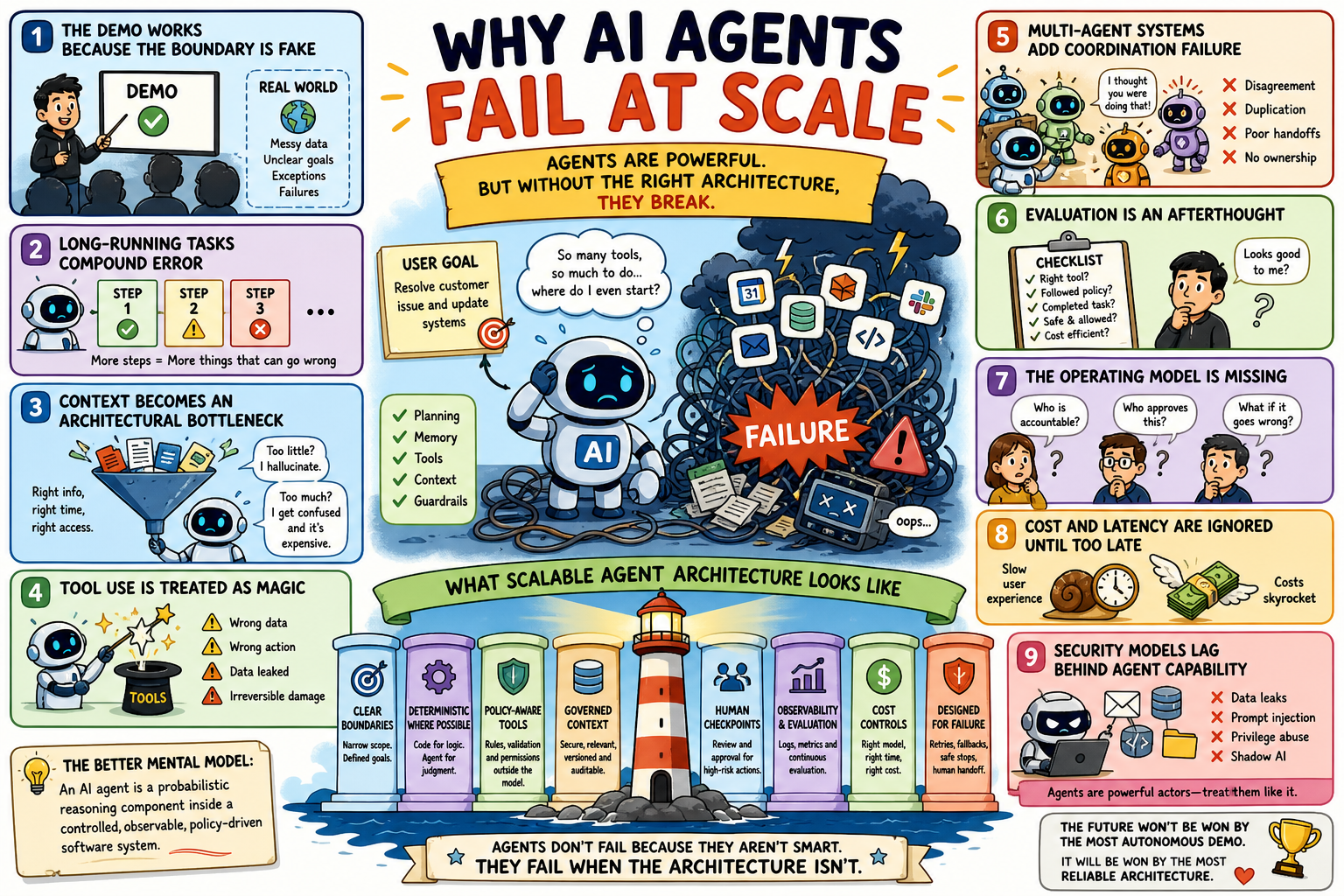
- Observability and Governance: Managing a swarm of agents requires sophisticated monitoring, logging, and governance frameworks to ensure they stay on task, avoid undesirable behaviors, and adhere to organizational policies.
- Security at the Agent Level: We need to consider how to secure individual agents, their access to tools, and their inter-agent communication channels.
The Future is Agent-Native
Just as microservices allowed us to build highly scalable, resilient, and specialized applications, multi-agent systems will enable us to construct truly intelligent, adaptive, and autonomous AI solutions. This isn’t just about making AI better; it’s about fundamentally changing the architectural patterns of software itself.
We are moving from a world of passive code that executes instructions to active systems where intelligent agents orchestrate processes, achieve goals, and even self-correct.
Are you ready to design the next generation of “Agent-Native” applications? The Microservices Moment for AI is here, and it’s time to embrace the swarm.