The technology industry has an incredible memory for forward-looking promises, but total amnesia for yesterday’s hype. Technologies that once dominated every podcast, keynote, and boardroom seem to disappear overnight.
Where do they go?
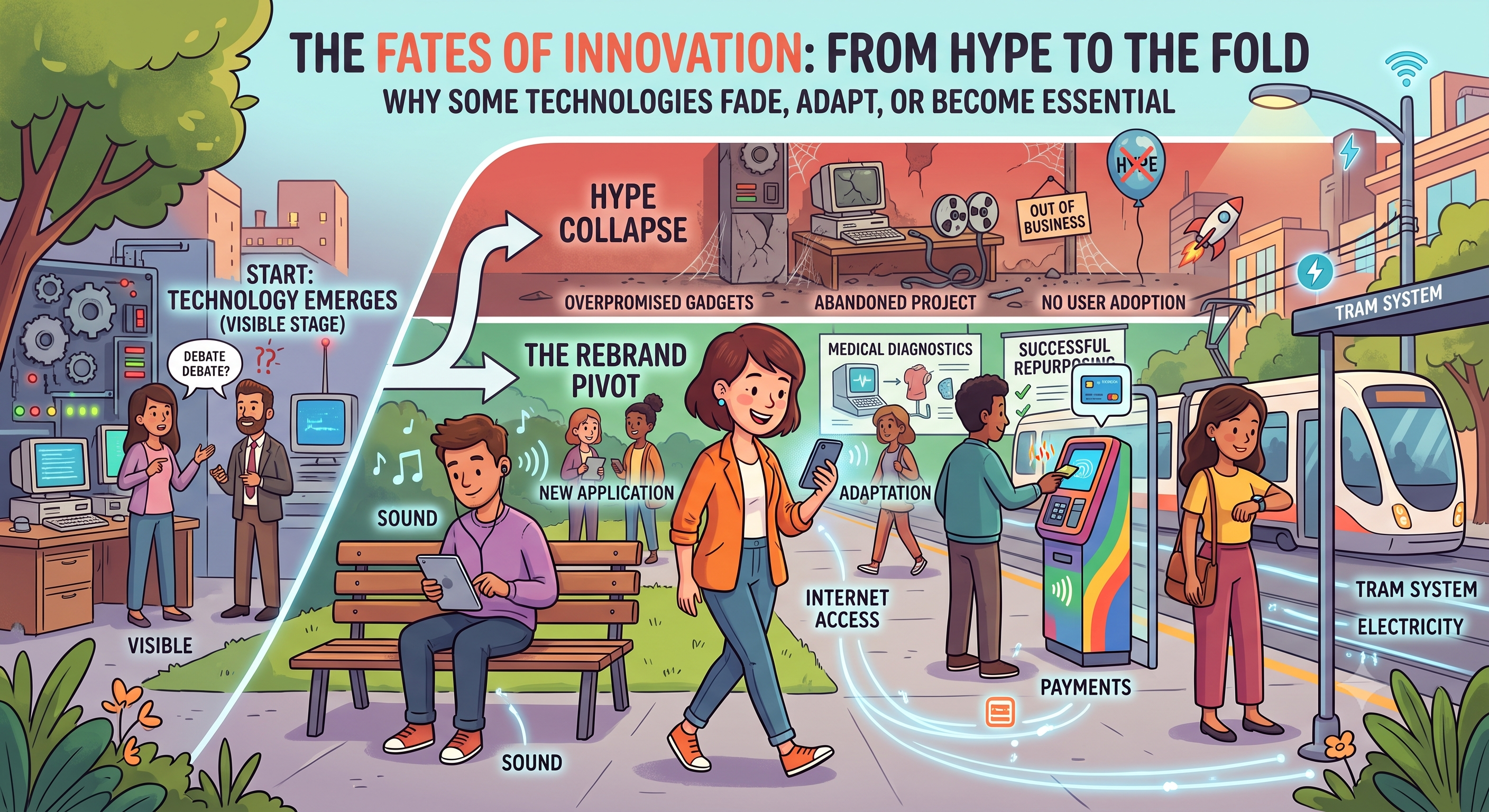
Most people assume technologies either succeed wildly or fail catastrophically. The reality is far more nuanced. When a technology drops out of the mainstream conversation, it usually follows one of three distinct paths: Hype Collapse, The Rebrand Pivot, or Invisible Ubiquity.
Path 1: The Hype Collapse (When Promises Exceed Reality)
Some tech trends disappear simply because the gap between marketing promises and real-world utility becomes impossible to bridge.
- Metaverse “Virtual Land”: During the peak boom, virtual real estate was touted as the next gold rush. But when speculation dried up, land values on major platforms like The Sandbox and Decentraland plummeted by 80% to 90%. Without core organic utility, the virtual real estate market unraveled.
- Hyperloop Transportation: Touted as a “fifth mode of transit” that would shoot passengers through vacuum tubes at 700 mph, Hyperloop failed to overcome extreme engineering, safety, and capital costs. The flagship pioneer, Hyperloop One, officially shut down and liquidated its assets after failing to secure a single commercial contract.
Path 2: The Rebrand Pivot (Surviving by Changing Names)
Not every failed trend dies. Some strip away their most absurd promises and re-emerge under a far more pragmatic name.
- VR Boardrooms -> Spatial Computing: Wearing a heavy VR headset to sit in a virtual office as a legless avatar was widely rejected by workers. However, the technology evolved. Rebranded as Spatial Computing, the focus shifted from virtual social spaces to practical industrial design, medical training, and high-precision simulation.
- Basic AI Wrappers -> Agentic AI: Simple user interfaces built on top of basic LLM APIs were quickly rendered obsolete by base model updates. Instead of dying, the trend evolved into Agentic AI—autonomous digital systems designed to independently plan, execute multi-step workflows, and make operational decisions. Gartner named Agentic AI a top strategic technology trend, forecasting its shift into an autonomous digital workforce.
Path 3: Invisible Ubiquity (Succeeding Into Boredom)
Some tech trends stop being talked about because they won so completely that they became boring.
This is The Invisibility Threshold: the point at which a revolutionary technology becomes so integrated into daily life that mentioning it sounds like bringing up indoor plumbing.
- 5G Infrastructure: Carrier marketing once framed 5G as a civilization-altering miracle. Today, it is simply the default signal icon on your phone—essential, ubiquitous, and completely unexciting.
- Consumer GPU Rigs: Consumer crypto-mining rigs disappeared overnight after major blockchain consensus shifts. Yet consumer graphics chips didn’t become obsolete; they were absorbed directly into the background infrastructure powering global AI model training.
The tech landscape isn’t defined by what we shout about today, but by the tools that quietly survive tomorrow.
References & Source Material
- Hyperloop One Shutdown: Moon, M. (2023). Hyperloop One is shutting down. Engadget / Bloomberg Report.
- Metaverse Real Estate Crash: Anadolu Agency / Global Times (2022–2024). Land prices in metaverse plummet due to declining interest.
- Agentic AI & Future Trends: Coshow, T., Gao, A., et al. (2024/2025). Top Strategic Technology Trends: Agentic AI. Gartner Research.
- Spatial Computing vs. Metaverse: Paul, S. (2026). Spatial Computing: Changing the Experience of the Metaverse. Ink In Caps Industry Reports.